
DixonBaxi / Technical Director
AskUs
Opening up 25 years of DixonBaxi’s thinking through a conversational studio archive.
My contribution
As technical director, I built the public experience, integrated AskUs into DixonBaxi’s main website, and created the admin dashboard that gives the team control over its content and behaviour.
The brief
DixonBaxi wanted to make its projects, philosophies and writing accessible to students, peers, prospective clients and the curious. The ambition was an archive people could explore through conversation.
Keeping the studio’s voice intact
A central decision was what AskUs should and should not claim. I kept retrieval grounded in the studio’s own material, with clear boundaries around when the system should defer. Its responses needed to reflect the work and thinking that already existed.
Giving the team control
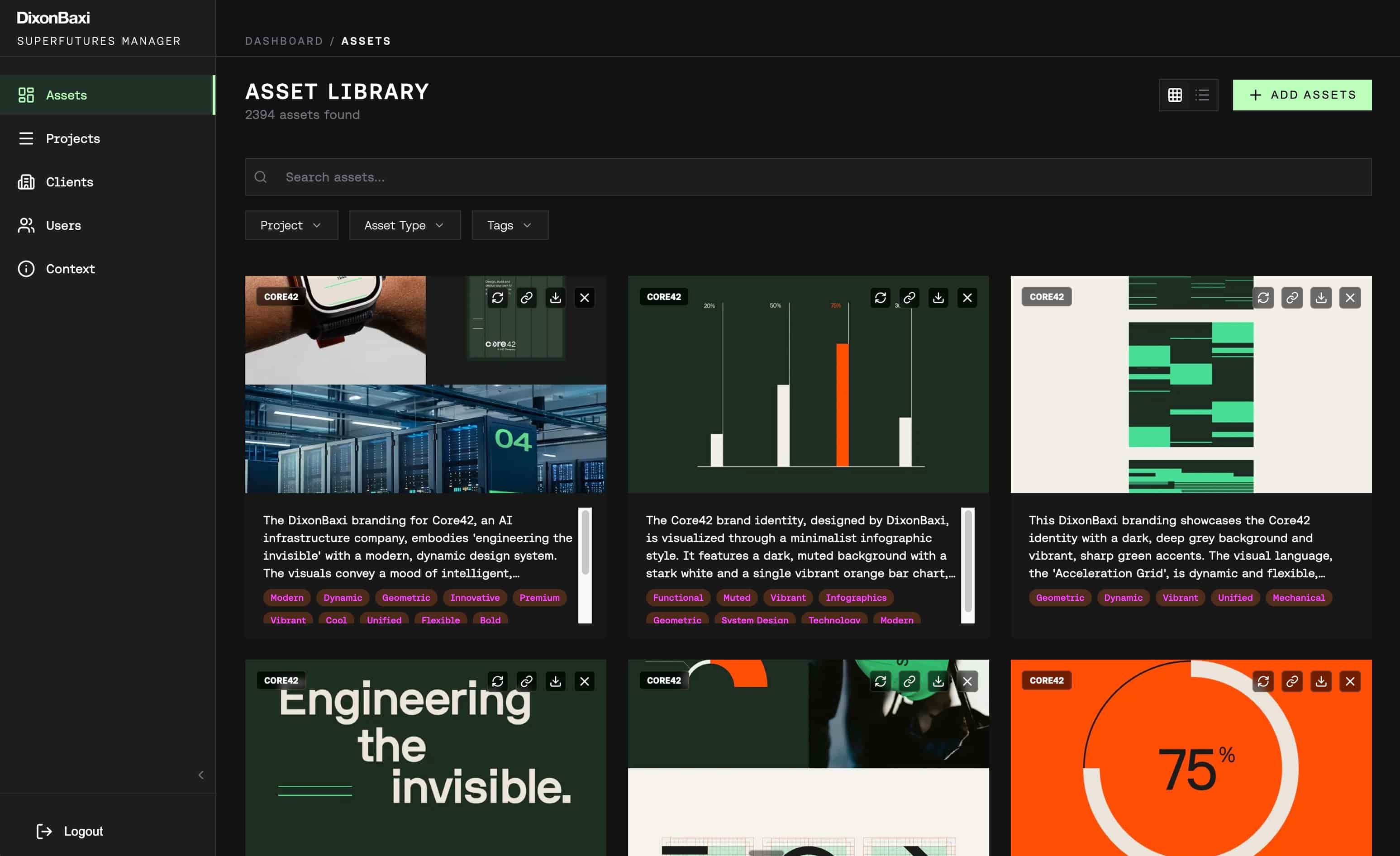
Alongside the public app, I built a dashboard for managing source material, projects, prompts and personas. The team can add content and reshape the system’s behaviour without touching code.
AskUs on the main website
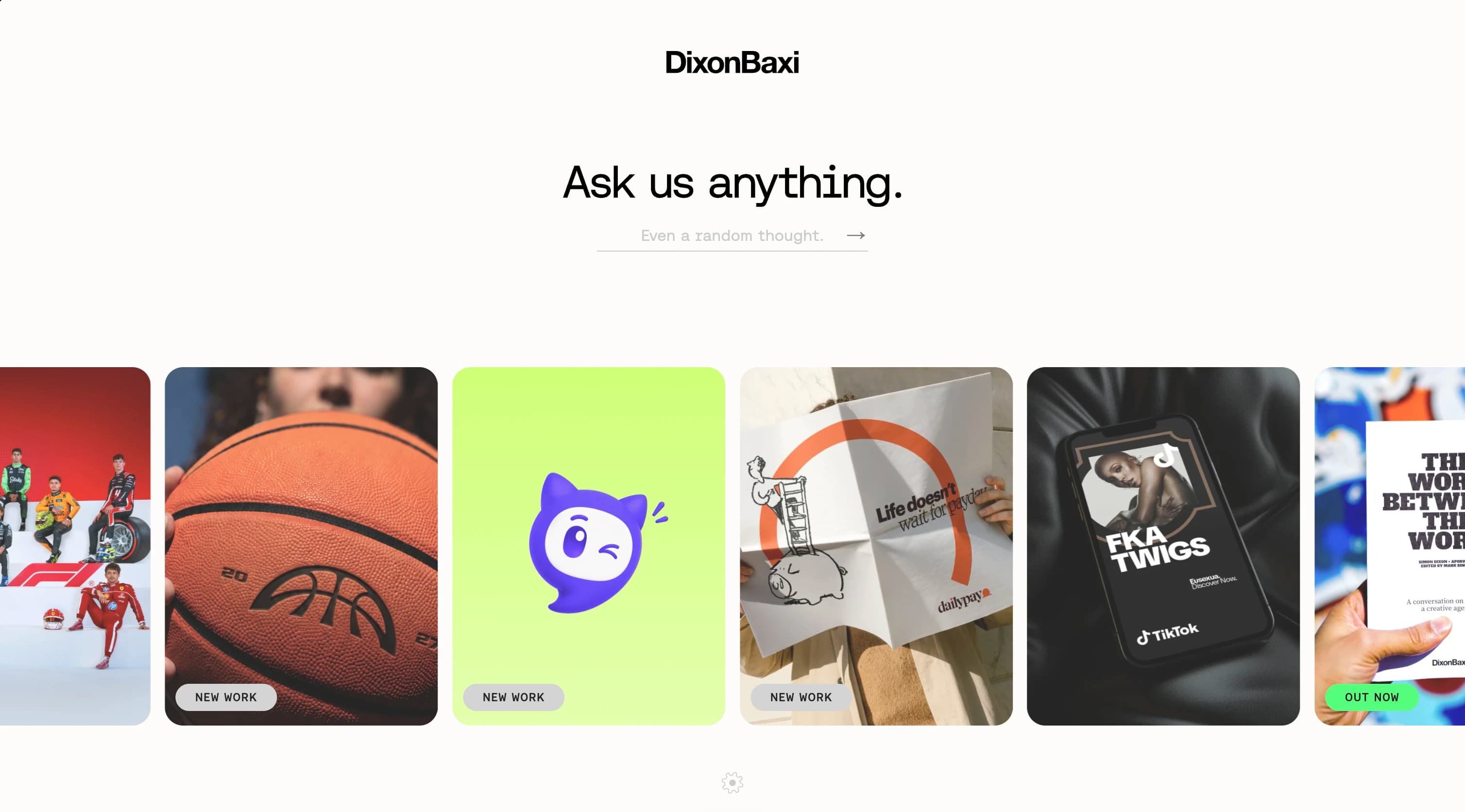
I integrated AskUs into DixonBaxi’s main website, bringing conversation into the way visitors discover the studio. Alongside browsing projects through the tile carousel, visitors can ask a question about DixonBaxi, its work or its approach and get an answer directly on the site.
A system that can keep growing
AskUs is live and free to explore. The public experience and the tools behind it give DixonBaxi a way to keep opening up its thinking as the studio evolves.
Technical detail & tools
The public app is a retrieval-augmented conversational interface running on Google Gemini 3 Flash, with pgvector for semantic search across thousands of vectorised assets, Vertex AI for reranking, and Zod-validated structured responses across six distinct intents (project, visual, jobs, team, process, general). Few-shot learning mirrors DixonBaxi's voice, and configurable personas adjust register depending on what's being asked. The dashboard handles the other half of the system: a streamlined ingestion pipeline that parses PDFs, text and markdown, chunks documents via LangChain, generates Gemini embeddings, and stores them in Postgres for retrieval. Admins can manage clients, projects and assets, tune system prompts and personas, invite users, and reshape the agent's behaviour without touching code. Both apps are built on Next.js 16, React 19, Prisma and Supabase with strict TypeScript throughout.
- AI Engineering
- RAG Systems
- Full-stack Development
- Product Architecture
- Creative Technology
- Next.js
- TypeScript
- Context Engineering

Explore another collaboration


Have a brief in mind?
An early idea, an upcoming pitch or a project already underway. Send me a short outline and we can talk through what it needs and where I could help.
Let’s talk about a project